Tron – Ares
A highly sophisticated digital program, Ares (Jared Leto), is sent into the real world on a dangerous mission, marking humanity’s first encounter with artificial intelligence. As Ares discovers his surroundings and makes his first contact with humanity, his awareness and consciousness begin to evolve. He finds an unexpected ally in the brilliant technologist, computer programmer, and Encom CEO Eve Kim (Greta Lee), who is searching for crucial code written by Kevin Flynn (Jeff Bridges).
The film begins with a CEO, already visibly unscrupulous due to operational differences with his mother, played by Gillian Anderson, of the large technology company Dillinger (a name perhaps not coincidentally contrasting with that of its competitor and more “good” company, Encom), creating from scratch, in front of a group of financiers and military brass, a tank that can even knock down walls, as if using a 3D printer, and an android soldier with the warrior name Ares, both ready “for all-out war at five minutes’ notice.”
Tron: Ares, infinitely more than the previous film, Tron: Legacy, but also than the original, a classic from the 1980s, is completely immersed in the present. Because the only possible future in this non-saga is precisely the present, which speaks to us of wars unleashed in five minutes. In this sense, it almost seems like an instant movie with the added theme of artificial intelligence, which is so much a part of our lives that we have become its hosts, not vice versa. Tron’s “grid,” the network in which its system operates, literally emerges from that virtual world to appear in ours, which we consider real. This leapfrog brings with it a series of fascinating, if not entirely original, theoretical questions. Because Ares, who—let’s remember—in Greek mythology is the god of war in its most aggressive and lawless state, is security software designed solely to protect the “grid,” which is now beginning to ask questions.
The somewhat basic screenplay by Jesse Wigutow revolves entirely around this idea of artificial intelligence developing a consciousness within software, a not-so-subtle reference to Asimov’s famous three laws of robotics. The interesting aspect of this evolution is the belief that AI can become a force for good against the evil represented by human intelligence. Free will, even that of software, is preserved since Ares, despite knowing he is, as repeatedly stated, “100 percent expendable,” chooses to respond to his evil programmer by rebelling and thwarting him, while his colleague Athena takes the path of blind obedience and becomes his enemy, as written in Greek mythology.
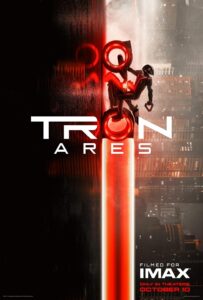
This clash, also in acting terms between Jared Leto and a very interesting Jodie Turner-Smith, is one of the most engaging parts of the film, which also finds its strength in the visual form that Norwegian director Joachim Rønning (Maleficent: Mistress of Evil and The Sea Princess), here in his most convincing performance, gives to this third chapter marked by the color red. This is the guiding principle of the entire film, which, as in its predecessors, finds its most evocative sequences in the story of the “grid,” with, for example, the physical representation of a hacking program opposed by the attacked system’s security program. The motorcycle chases in the real metropolis are a bit more familiar (Terminator?), though their execution is impeccable, thanks in part to Tyler Nelson’s editing. Pietro Scalia also had a hand in editing them, as we discover in the closing credits, which also feature the inevitable sequence that could lead to a further but unnecessary sequel. Thanks to them, the film has a faster pace than its predecessors, slowed only by the forced introduction of Kevin Flynn, played by Jeff Bridges, who is always a pleasure to watch again, even when he’s philosophizing.
The soundtrack, composed by Trent Reznor and Atticus Ross, who chose to collaborate with their group Nine Inch Nails and serve as executive producers, deserves a separate review. Their electronic music, which positively stuns the viewer, offers an escape, also leading them to relive certain atmospheres of ’80s video games that, in fact, were based on very thin stories. Like this one.