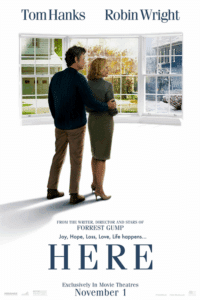
Here
A prehistoric land, and the house that will be built on that land. That house will host generations of families, from Homo sapiens to indigenous peoples to settlers, all the way to a contemporary African-American household. And in the living room of that house, lives will unfold, ever different yet always the same, populated by husbands, wives, children, grandparents, and grandchildren.
Robert Zemeckis’s empathetic gaze observes them, framing them in rectangles that break down and reproduce the geometric dimension of the big screen, enclosing everyone in a space that is at times a refuge and at times a trap, an enchanted treasure chest and a mortuary, a place of creation—of art, of progeny, of hope—or of quiet implosion and regret, in a film that is a magic box, a pop-up book, and a Russian doll of human existence.
The “here” and now becomes the here and now, because the unity of place does not correspond to a unity of time. On the contrary, time is fragmented, shaken, misaligned, and made eternal in its repetitiveness, recounting the journey of countless families living in that one place—joys and tragedies, births and deaths, and that limited number of Thanksgivings and Christmases that mark time, for all of us, within the circle of (our) lives. “Time flies,” a character will repeat, and in an instant what seemed infinite becomes fleeting, a Polar Express already past, where we discover ourselves to be passengers rather than drivers. And perhaps we will say to ourselves: “I wish I could have done more, with these years.”
The feeling, for the spectator as well as for the characters on stage, is both claustrophobic and familiar. Zemeckis creates a poignant parable of life, even addressing the inevitability of death, which comes suddenly and unexpectedly. This parable also encompasses the essence of the director’s cinematic journey, which references itself countless times: through the Allied-branded moving boxes, through Benjamin Franklin searching for lightning like Doc in Back to the Future, or a pilot risking his life like the one in Flight, and of course through the film’s central couple, played by Tom Hanks and Robin Wright, who were the tender hearts of Forrest Gump.
The only family that faces life with inexhaustible joy is the bohemian one that devotes itself to art and invents a “magic” armchair that keeps its feet off the ground: and feet are always symbols, in Zemeckis’s cinema. The director moves his figurines like an existential diorama à la Welcome to Marwen, exorcising the fear of living, and especially of dying: emblematic is the scene in which, in that room we’ve been observing throughout the film, we fail to notice a lifeless body lying on the floor, inside that rectangle we call life.
Here is the melancholy and tender work of a seventy-year-old director who has always hungered for life, and who has portrayed it as a surreal adventure (Back to the Future), an unfathomable mystery (Contact), even a farce tied to our illusions (Death Becomes Her). His protagonists can become innocent cartoons because they’re “drawn that way” (Who Framed Roger Rabbit?), ghosts (A Christmas Carol), wooden puppets longing to become human (Pinocchio). Some lose themselves (Cast Away) to find greater awareness, others become aware by discovering hidden truths. And everyone walks on a tightrope strung above nothingness (The Walk), balancing between life and death, sometimes throwing themselves into the void in the hope of finding safe footing (Allied) because life is uncertain, but full of possibilities.