Predator – Badlands
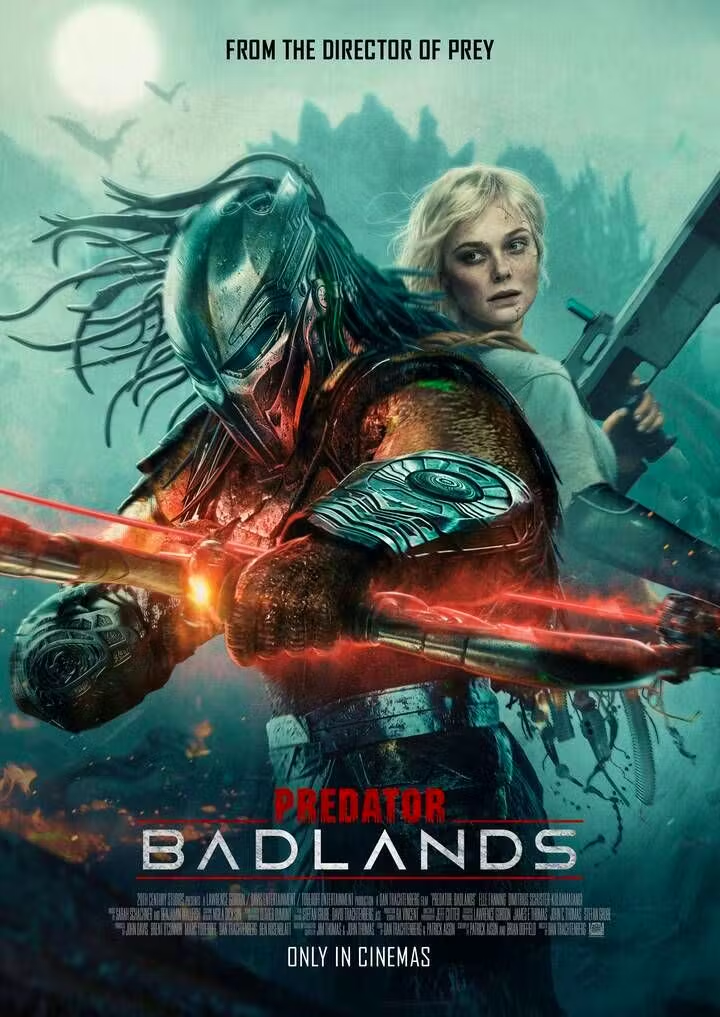
Still considered too young and weak by his older brother, Dek is a Yautja desperate to prove his worth and earn the “mantle,” the invisibility system that makes his species one of the most dangerous in the galaxy. When his father demands his head and his older brother opposes, his father decides that his brother is also too weak for the clan and challenges him to a duel to the death. Dek is trapped in his brother’s ship, and the vessel departs for “the most dangerous planet in the universe,” home to the mythical Kalisk, a creature with extraordinary regenerative abilities that no Yautja has ever managed to slay. On this treacherous world, Dek will find two unexpected allies: a small primate-like creature with a hard shell on its back; and a legless android, unable to walk but rich in knowledge of the world they find themselves on.
Predator: Badlands marks a new attempt at a reboot for the franchise dedicated to ferocious alien hunters, and this time the protagonist is one of them.
The most interesting idea, however, isn’t the reversal of perspective, but rather the pairing of the stoic, determined, and vengeful alien with a disabled android with an unshakeable good humor. This unprecedented odd couple, featuring Elle Fanning with her impeccable comic timing, gives the film a vitality it almost doesn’t deserve. The project is indeed contradictory and paradoxical: the antiheroes fight against the androids of an Earth-based corporation, but the film follows a clear Disney corporate mandate: to reconnect with Alien, creating a sort of space monster universe. Furthermore, there’s no shortage of Disney-esque “cuteness” with the comical creature, which seems ready to be turned into a toy. Furthermore, having eliminated the humans and replaced them with androids allowed the film to receive a mild censorship rating in America, despite its presence of violent (but bloodless) scenes.
In short, it’s the complete opposite of the radical return to origins of the previous film, Prey, of which only one thing remains: director Dan Trachtenberg’s ability to conceive and shoot good action scenes featuring the alien hunter. Here, however, they are taken to a less tense and more immediately spectacular level, with large monsters, traps, and heavily armed adversaries far more dangerous for the alien than the natives and colonists of the previous film.
The protagonist, Dek, however, besides being entirely digital like a Warcraft orc or a Na’vi Avatar, is constantly angry, and his fury, while justified by the wrongs he has suffered, quickly becomes tiresome. So much so that his successes, though well-choreographed, aren’t enthralling, both because they lack the true athletic prowess of a live-action scene and because they lack the stylization of a fully animated film like Predator: Killer of Killers, also produced by Trachtenberg.
There’s another paradox in Predator: Badlands, namely that the film only becomes interesting when the alien is joined by the android, who, despite being an artificial intelligence, reveals herself to be a more human and complex character than him. She, moreover, mirrors him, having her own “family” problems and, like him, is considered an outcast. In her case, the reason isn’t physical but rather a programming anomaly, a sort of bug that gives her a personality irreconcilable with that required by the corporation she’s supposed to obey: the monolithic Weyland-Yutani of the Alien films. Another android, again played by Elle Fanning, is hot on her trail as well as the Kalisk, and will eventually clash with her and Dek. Here the film finds its best scene, when the legless android gains control of separate lower limbs. She thus fights as two distinct halves, torso and legs, in scenes that combine action and slapstick with amusing originality.